Boulder Pushers
- 1.6
- Rating
- 100.00K
- Installs
- Free
- Price

 Analysis by App-foxy
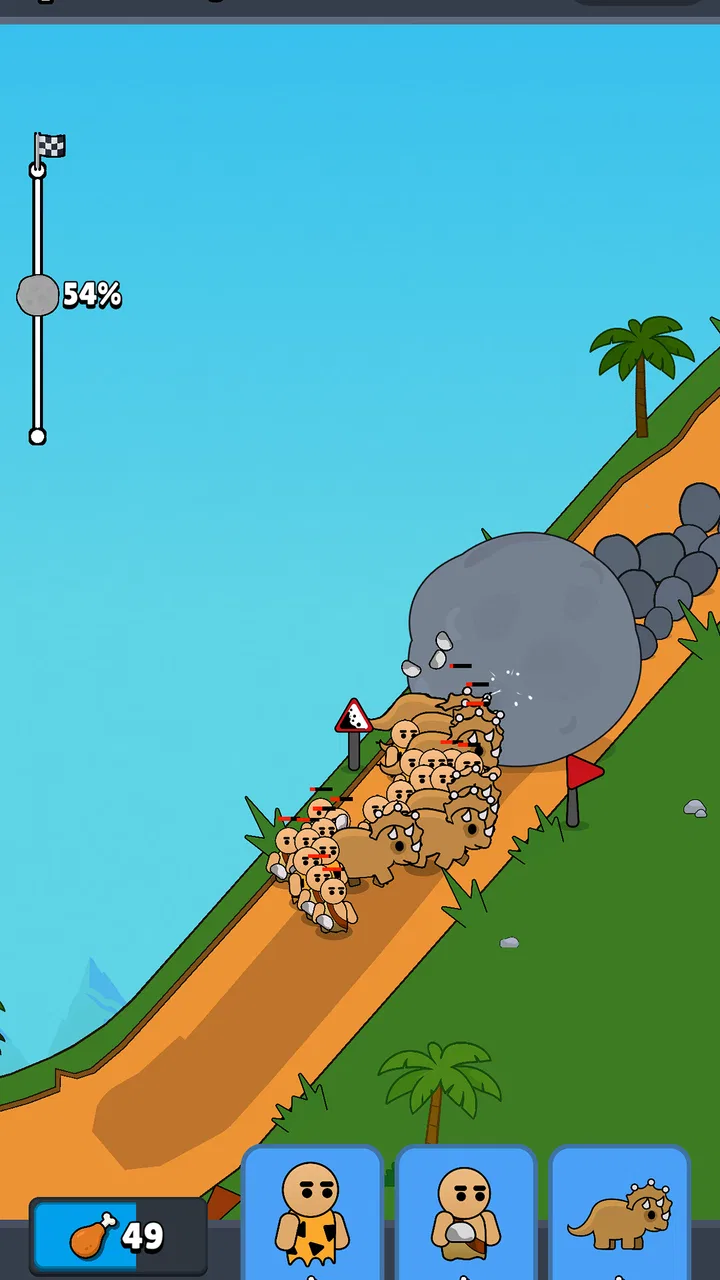
I went into Boulder Pushers expecting a quick action game built around a simple physical idea: move heavy objects, make progress, and keep adapting as the world changes. That basic premise is easy to understand, but the experience is more interesting when you stop treating each boulder as something to shove blindly and start thinking about timing, positioning, and the safest route forward. It is the kind of game I can imagine opening for a short break, especially when I want something more active than a puzzle but less demanding than a large, story-heavy action title.
The game comes from PlayWill and is free to download, with optional purchases ranging from $0.99 to $9.99 per item. It is listed for Everyone, which makes the concept approachable for a broad audience, although the action-focused design may still appeal most to players who enjoy repeated attempts and learning through small mistakes. The store summary, “Evolve in Ages!”, suggests that progression through different eras is central to the identity of the game, while its short description, “Boulder Pushers,” keeps the promise deliberately direct.
My overall reaction is mixed but curious. The central idea has enough personality to stand apart from a routine arcade game, and the low entry cost makes trying it easy. At the same time, the current release feels like a starting point rather than a fully mature action experience. The average rating is 1.6 from around 220 ratings, so I would not ignore the warning signs. I would approach it as a free experiment, not as a polished replacement for the biggest action games on mobile.
You May Also Like

 Blood Strike: 2.5 Anniversary
Blood Strike’s Loadouts Turn Every Drop Into a Tactical Gamble
A close look at Blood Strike’s custom loadouts: how fast access to signature weapons reshapes its battle royale rhythm, rewards preparation, and narrows the gap between fights.

 Pandora - Music & Podcasts
Pandora’s Music Is Easy to Start, but Harder to Recover
Pandora’s strength is its low-effort path from a seed to a station. Its weak spot is how much confidence it asks you to place in connection, setup, and quiet recovery.

 8 Ball Pool
 Is Built on Rivalries, Rematches, and Routine
A close look at the rivalries, rematches, shared routines, and unanswered safety questions that turn a quick pool match into a persistent mobile community.

 Samsung Music
’s Quiet Strength Is Playing What You Already Own
Its reach comes less from spectacle than from dependable access to a personal library. That simplicity is both the app’s strongest retention engine and its ceiling.

 AccuWeather: Weather Radar
AccuWeather Review: A Quick, Clear Forecast for Everyday Decisions
For everyday plans, the best forecast is the one you can understand quickly. AccuWeather makes rain timing, radar, and local conditions easy to act on, with a few trade-offs.

 Hill Climb Racing
Why Hill Climb Racing Still Turns Crashes Into One More Run
A tiny car, a bumpy hill and one more upgrade: Hill Climb Racing keeps resurfacing because its simple chaos makes every near-miss feel personal.
More From Our News Desk
View All News


How the current version feels to play
The most appealing part of Boulder Pushers is the way a familiar object becomes the main source of movement and decision-making. A boulder is not just a target to destroy or collect; it is something that changes how you think about space. When a route is blocked, the obvious reaction is to push harder or move faster, but the better solution is often to pause and consider where the object will end up. That gives the game a physical rhythm that separates it from action titles based only on tapping enemies.
I found that the game works best when I treated every push as a commitment. Once a large object begins moving, correcting the situation may be less convenient than preventing the mistake in the first place. That creates a useful tension between speed and control. Rushing can help when the path is clear, but careful movement matters more when the environment becomes crowded or the next stage expects a particular route.
The “ages” concept also gives the game a sense of forward movement beyond simply clearing one challenge after another. Even without relying on a complicated story, changing eras can make progression feel meaningful. The important question for players is whether those changes affect the way the game is played or merely provide a new visual setting. In my experience with this type of design, the strongest version is one where each new period encourages a different approach to pushing, turning, and planning rather than just changing the background.
That is where the game can be surprisingly thoughtful. A player who normally avoids puzzle games may still enjoy it because the action keeps the pace moving. A player who normally prefers pure arcade controls may find the need to plan slightly slower than expected. Boulder Pushers sits between those styles, and that middle ground is both its main attraction and one of its risks.
Why the boulder mechanic matters
The boulder itself creates a useful distinction between immediate action and delayed consequences. In a conventional action game, a missed tap may cost a moment. Here, a poor push can affect the next several decisions because the object occupies space and changes the available route. I recommend using the opening moments of a challenge to learn how much room you have before committing to a fast sequence. That small habit can prevent many avoidable resets.
Another practical approach is to separate movement into two intentions: positioning the boulder and making progress toward the objective. Those goals are not always identical. A push that appears to move the boulder closer to the destination may leave it awkwardly placed for the next action. When I focused first on creating a clean angle, later movement became more predictable. It is a simple technique, but it makes the experience feel less random.
This also explains why the game may not suit everyone. If you want an action title where constant speed is always rewarded, the physical object can feel like an obstacle to your preferred style. If you enjoy reading a situation, making a decision, and then seeing the result unfold, the same feature becomes the reason to continue.
Progression through changing ages
The age-based structure gives players a reason to keep going after the novelty of the first boulder pushes wears off. I like the idea because it can make a short session feel connected to a longer journey. Instead of viewing each challenge as an isolated room, you can think of the game as a gradual evolution of its central mechanic.
For that structure to stay engaging, the transitions need to do more than decorate the same activity. A new age should ideally change what I prioritize: perhaps one section rewards speed, another makes careful positioning more important, and another tests whether I can recover after a poor push. The current version gives the concept a foundation, but I would keep my expectations measured. The available release is version 1.0.5, so I see it as an early stage in the game’s development rather than proof of a fully expanded long-term system.
That version number is worth mentioning for existing players. It indicates that the game has moved beyond its first public build, but it does not automatically tell me that every rough edge has been resolved. In practical terms, I would update before judging the experience because the current build is the one that represents PlayWill’s present direction. I would also avoid assuming that future changes are guaranteed. The game’s potential is clear, but potential is not the same as confirmed content.
What the release means for new and returning players
For a new player, the biggest advantage is the low-risk entry point. Because the game is free, I can test its movement style without committing money first. That matters here because the central mechanic will divide people. Some players will immediately enjoy the deliberate weight of the boulders, while others will find the pace or control less satisfying than a conventional action game.
My advice is to give it a focused trial rather than judging it after a single awkward attempt. The first few minutes are mostly about understanding how the game wants me to think. I would pay attention to whether mistakes feel informative or merely frustrating. If each failed push teaches me something about spacing and timing, the game has a reason to stay installed. If I feel that outcomes are unclear and improvement is difficult to connect to my decisions, it is probably not the right fit.
Returning players should look at version 1.0.5 as the current checkpoint in the product’s evolution. The game is no longer only an idea built around a catchy object; it is a live release with enough presence to have passed the 100K+ install mark. That reach does not guarantee quality, but it does mean there is a real audience trying the concept and forming opinions about it.
The low average rating should shape expectations more than the install count. A large number of downloads can show curiosity, but a 1.6 average suggests that many players have encountered problems or simply did not enjoy the result. I would not treat that rating as a complete verdict, since ratings often combine reactions to controls, difficulty, presentation, and expectations. Still, it is a strong reason to avoid spending on optional items until I know that the core loop works for me.
A realistic everyday use case
Imagine having ten minutes before an appointment. I would open Boulder Pushers because it does not require me to learn a large cast of characters or remember a complicated story. I could attempt a few challenges, experiment with a safer way to move a boulder, and stop when the appointment begins. That short-session use is where the game makes the most sense to me.
It could also work as a casual choice for a family member who likes action but does not want an aggressive combat theme. The Everyone content rating makes it easier to consider in that setting, although I would still try the game personally before recommending it to a younger player. The rating describes the intended audience, not whether every control decision will be immediately comfortable for every age group.
On the other hand, I would not choose it for a long commute if I wanted a deep campaign with a strong narrative or a highly competitive system. The boulder mechanic encourages concentration, and repeated attempts can become tiring if the game does not keep introducing fresh situations. For a longer session, I would prefer an action game with more varied combat, exploration, or character development.
How it compares with familiar alternatives
Compared with a standard arcade action game, Boulder Pushers asks for more patience. Traditional arcade design often rewards fast reactions above all else. Here, quick reactions help, but they do not replace planning. That makes it a better choice for someone who wants action with a light strategic layer, and a weaker choice for someone looking for nonstop speed.
Compared with a conventional physics puzzle, it appears more active and immediate. A pure puzzle can let me spend a long time studying a board before making one move. Boulder Pushers has a more physical, hands-on feeling because the main object is pushed through an action-oriented environment. The trade-off is that players who love quiet, highly precise puzzle solving may prefer a title designed entirely around careful logic.
It also differs from large evolution-themed games. The phrase about evolving through ages might make some players expect a broad management or civilization-building experience. I would not approach it that way. The useful expectation is a focused action game whose identity is tied to boulder movement and progression through eras, not a full strategy simulation. That distinction can prevent disappointment before downloading.
Where the current release still needs work
The first concern is clarity. A physical mechanic is only satisfying when I understand why a boulder moved the way it did and what the game expected me to do next. If the visual feedback, collision behavior, or objective wording is unclear, frustration can feel unfair rather than earned. This is especially important for a game aimed at Everyone, because accessibility depends on teaching the rules without assuming prior experience.
The second concern is variety. The central idea is memorable, but one mechanic cannot carry every session unless the situations around it keep changing. The age structure gives PlayWill a natural way to introduce fresh challenges. I would like to see each era justify its place through new interactions or distinct problem-solving demands. If the game only changes scenery while asking for the same push repeatedly, the novelty will fade quickly.
The third issue is the balance between free access and optional purchases. The game costs nothing to start, which is a genuine advantage, but in-app items run from $0.99 to $9.99 each. I would keep purchases separate from my first evaluation. First decide whether the movement is enjoyable, then consider whether an item improves convenience without replacing the satisfaction of learning the mechanic. For younger players, purchase controls on the device are especially important because the listed age rating does not remove the need for sensible spending boundaries.
I also think the game must earn trust through updates. A version such as 1.0.5 suggests ongoing development, but players will judge that development by how clearly future improvements address friction. Better explanations, smoother progression, and more meaningful differences between ages would do more for the game than simply adding content that uses the same pattern.
Who should try it, and who should skip it
I would recommend trying Boulder Pushers if you like compact action games with a physical twist, enjoy learning from failed attempts, or want something that can fit into short breaks. It is especially attractive if the idea of pushing an object through changing eras sounds more interesting than another game built around familiar weapons and enemies.
I would skip it if your priority is polished competitive play, a substantial narrative, or instantly responsive arcade movement. I would also be cautious if you dislike repeating a challenge after a positioning mistake. The game’s appeal depends on accepting that the right move may be slower and less obvious than the first move that comes to mind.
For most people, the sensible approach is to treat the free download as a test. Do not buy optional items immediately, and do not let the age theme create expectations of a large strategy game. Spend enough time to decide whether the boulder physics and progression loop feel rewarding. If they do, the game may become a pleasant niche action title. If they do not, a more conventional arcade game will probably provide faster satisfaction.
What I would watch as PlayWill continues
The next important sign will be whether the game’s ages become mechanically distinct. New environments are welcome, but the strongest update would make me change my habits from one age to the next. I would look for challenges that reward different forms of planning rather than simply asking me to push more objects in the same way.
I would also watch how the developer responds to the low rating. The rating is not automatically a diagnosis, but it is a clear signal that the current experience has not worked for enough players. If future versions improve onboarding, explain objectives more clearly, and make movement feel dependable, the game could convert curiosity into lasting interest. Those are expectations, not promises, so I would judge them only when changes actually arrive.
For now, my recommendation is cautious: download it if the concept genuinely appeals to you, but keep the purchase decision on hold until the core loop proves itself. The best reason to play is the unusual relationship between action and physical positioning, not the promise of a larger game that may arrive later. That distinction keeps the decision fair.
In the end, Boulder Pushers is a free action experiment with a recognizable hook and room to grow. PlayWill has chosen a mechanic that can produce more thoughtful moments than its short description suggests, especially when I stop rushing and plan each push. Yet the low user rating and early version mean I cannot call it a finished standout. I would recommend it to curious players who enjoy testing unusual mechanics, while friends seeking a polished, content-rich action game should look elsewhere for now.
FAQs for Boulder Pushers
01What is Boulder Pushers and how does the gameplay work?
Boulder Pushers is a puzzle-focused game built around moving large boulders through obstacle-filled levels. You must plan each push carefully, clear paths, avoid blocking narrow passages, and reach the required positions or goals. The controls are generally easy to understand, but the puzzles become more demanding as new layouts, hazards, and movement restrictions are introduced. It is best suited to players who enjoy thoughtful, slower-paced challenges rather than fast action.
02Is Boulder Pushers free to download and play?
Boulder Pushers can be downloaded without an upfront purchase on supported platforms, although the exact monetization system may depend on the version available for Android or iOS. Some editions may include advertisements, optional purchases, or other limitations that are not present in a premium release. Before installing, check the official store listing for current pricing, in-app purchase details, and whether an internet connection is required for certain features.
03Does Boulder Pushers work offline?
The main puzzle experience in Boulder Pushers may be playable offline, which makes it convenient for travel, commuting, or areas with unreliable connectivity. However, store verification, advertising, updates, cloud synchronization, leaderboards, or other online services could require an internet connection. If offline access is important to you, launch the game after installation with connectivity disabled and confirm which modes remain available on your particular device and app version.
04Is Boulder Pushers suitable for children and casual players?
Boulder Pushers is generally approachable for casual players because its core objective is straightforward: understand the level, push the boulders, and solve the layout. Nevertheless, later stages can require patience, spatial reasoning, and several attempts, so younger children may need help with planning difficult moves. Parents should also review the platform’s age rating, advertising policy, and any purchase options before allowing unsupervised play.
05What devices and permissions does Boulder Pushers require?
Compatibility depends on the specific Android or iOS version, so you should review the official download page for supported operating-system versions and minimum device requirements. Puzzle games typically need modest storage and performance, but older phones or tablets may experience slower loading or reduced compatibility. During installation, pay attention to requested permissions and avoid unofficial download sources, since the official store listing provides the safest and most current version.
Pros
- Simple controls make the game easy to pick up.
- Short levels are convenient for quick gaming sessions.
- Puzzle mechanics reward planning rather than fast reflexes.
- Increasing difficulty keeps later stages engaging.
- The minimalist presentation keeps attention on the puzzles.
Cons
- Some puzzles may feel repetitive after extended play.
- A few levels can be frustrating without trial and error.
- The game may offer limited variety beyond its core mechanic.
- Progress can feel slow for players seeking rapid rewards.
- It may not appeal to users who prefer action-heavy games.

Boulder Pushers
Gallery